
Better Together is an ongoing series spotlighting the integration partners our customers are already running alongside 7AI. Each post covers a real use case, a real workflow, and the outcome that comes from two platforms working together.
Cloud security teams have gotten very good at finding problems. They have platforms that surface misconfigurations, prioritize vulnerabilities, detect active threats in real time. The signal has never been sharper.
The hard part hasn't been finding things. It's been figuring out what to do about them – fast enough, consistently enough, at scale.
When a cloud detection fires, someone has to investigate it. They have to correlate it against identity data, endpoint telemetry, network logs, and prior activity. They have to determine whether it's a genuine threat, a misconfiguration, or something benign that just looks suspicious. They have to decide whether to escalate, remediate, or document and move on.
That work – repeatable, expert, time-sensitive – is exactly what AI agents are built for.
Today we're highlighting our integration with Upwind – a combination our customers are already running in production.
What Upwind Does
Upwind is a cloud-native application protection platform (CNAPP) that combines runtime context with security posture management across workloads, identities, APIs, and applications. Unlike platforms that generate static snapshots of risk, Upwind uses real-time runtime intelligence to prioritize what actually matters – surfacing the threats that are exploitable right now, not just theoretically concerning.
The result is a dramatically smaller, higher-fidelity signal: fewer alerts, but each one with rich context about why it's real and how critical it is. That's a significant achievement. But a prioritized alert still requires investigation before it becomes a decision.
What Happens When 7AI Takes It From There
When Upwind surfaces a prioritized cloud detection, 7AI's agents take it immediately. There's no queue. No analyst manually opening a new investigation. No pivot between platforms to gather context that already exists.
7AI's agents correlate the Upwind finding against the full enterprise environment – identity and access data, endpoint activity, prior incidents, threat intelligence – and work toward a verdict. They surface a clear investigation report with recommended next steps. And when the finding requires action, they route it to the right person with the right context to act.

The net effect: Upwind narrows the signal.
7AI closes the loop. Security teams get cloud threat investigations completed autonomously, in minutes, without requiring an analyst to context-switch between tools every time a finding fires.
Three Joint Use Cases
Cloud Threat Investigation at Scale
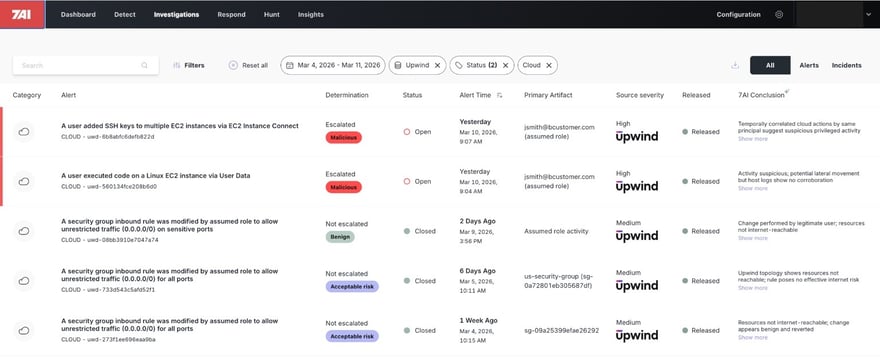
Upwind detections feed directly into 7AI. AI agents investigate each one – correlating across the enterprise, assessing severity, and surfacing a verdict – without an analyst having to manually triage or pivot between platforms. High-volume environments get consistent investigation coverage, regardless of alert volume.
Accelerated Remediation
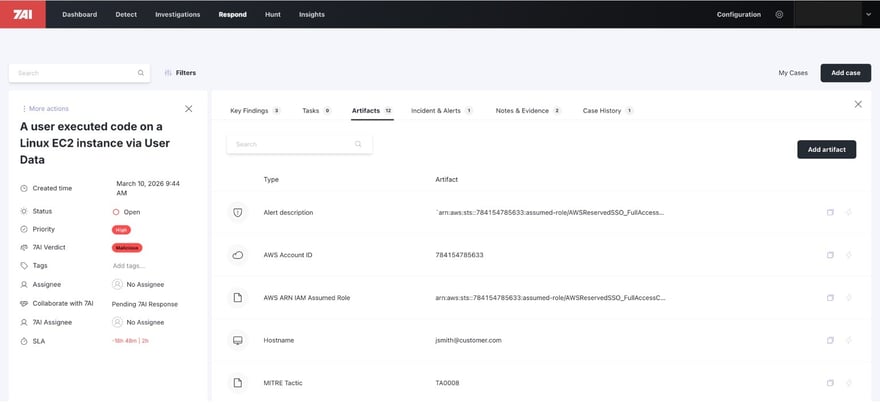
When an Upwind finding requires action, 7AI routes it with full context: what was found, what the investigation revealed, and what the recommended response is. Teams spend less time reconstructing context and more time fixing real issues.
Continuous Risk Communication
7AI translates Upwind's technical findings into clear, structured communication for security leaders and engineering teams. Cloud risk becomes something that can be tracked, communicated, and acted on across the organization – not just visible to whoever has Upwind open.
What Customers Are Saying
-1.png?width=800&height=368&name=SECURITY%20INNOVATORS%20DINNER%20(6)-1.png)
Why This Combination Works
Upwind and 7AI share a view of how enterprise security should work: surface what matters, then act on it intelligently.
Both platforms are deployed at Fortune 500 scale. Both are built around the idea that security teams shouldn't be spending their expertise on work that can be systematically handled by AI agents. And they serve the same buyer – the security team that wants to move faster without growing headcount or sacrificing quality.
This is part of a broader pattern we see across our customer base: best-in-class detection platforms feeding into 7AI for investigation and response. Upwind is one of them – and one our customers are using to real effect today. The future of security operations is a set of specialized platforms working together, each doing what it does best. Upwind owns runtime cloud visibility. 7AI owns the investigation and response layer. Together, they give security teams cloud threat investigation that doesn't require a human to initiate every single time.
Interested in how 7AI and Upwind work together in your environment?
We'd be glad to walk you through it.



.jpg)